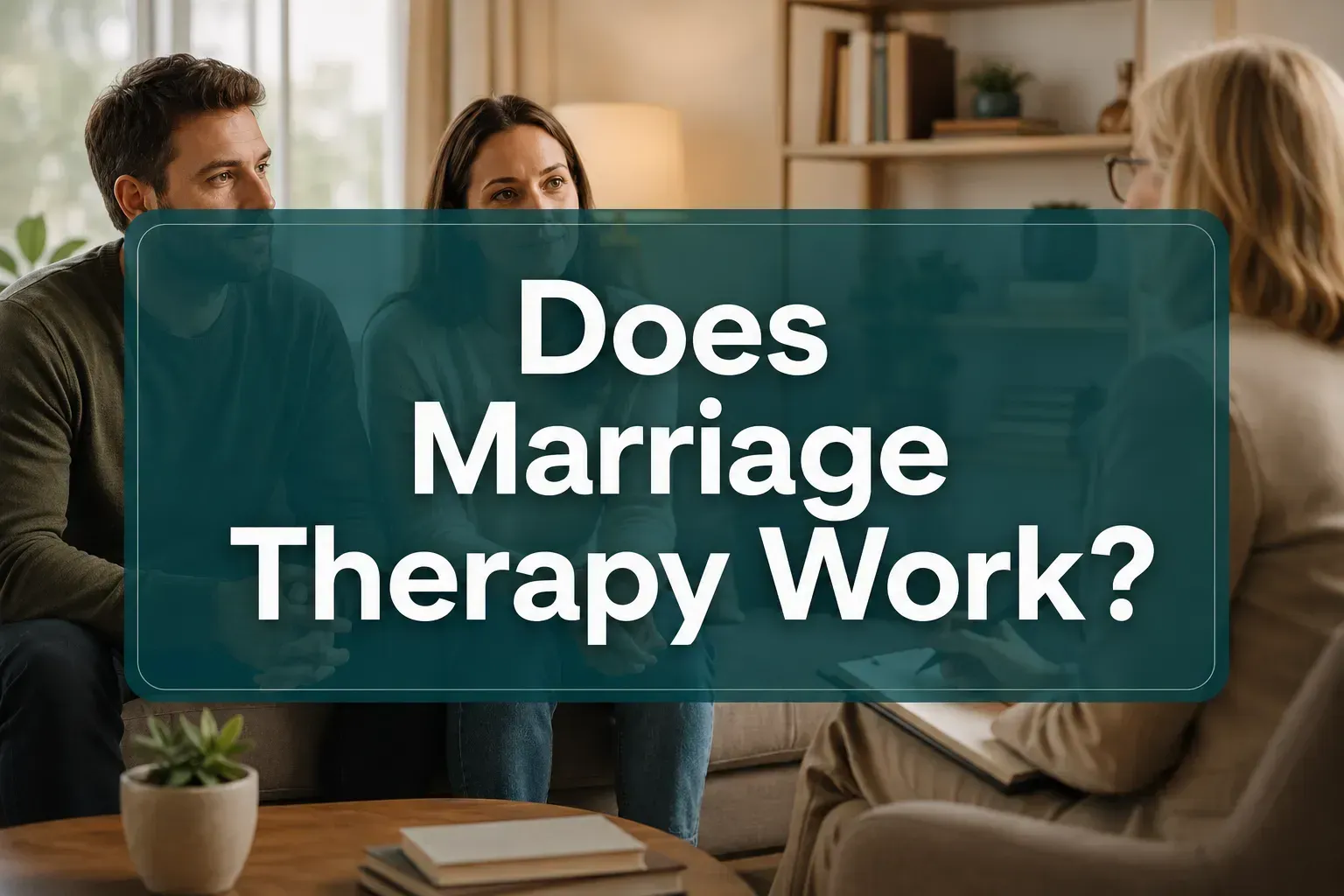

Quick Answer: The right couples therapist is a licensed mental health professional with specific training in relationship therapy, a therapeutic style that fits both partners, and a personality that makes both of you feel safe and heard. Start by checking credentials, asking about their approach to couples work, and scheduling a consultation to see if the connection feels right.
Key Takeaways
- A qualified couples therapist should hold a valid state license (LCSW, LMFT, LPC, or PhD/PsyD) and have specific training in evidence-based couples therapy methods.
- Marriage counselor and couples therapist are often used interchangeably, but a licensed couples therapist typically has broader clinical training.
- Couples therapy works best when both partners are willing to engage, but one partner starting alone can still be a productive first step.
- Common evidence-based approaches include the Gottman Method, Emotionally Focused Therapy (EFT), and Cognitive Behavioral Couples Therapy.
- Costs typically range from $100 to $250 per session; many practices offer sliding scale fees or accept insurance.
- Online couples therapy is effective and widely available, making it easier for busy or geographically dispersed couples to access care.
- Red flags include a therapist who takes sides, skips an intake assessment, or lacks specific training in relationship work.
- Most couples notice meaningful progress within 8 to 20 sessions, though this varies by the complexity of the issues involved.
What Qualifications Should a Couples Therapist Have?
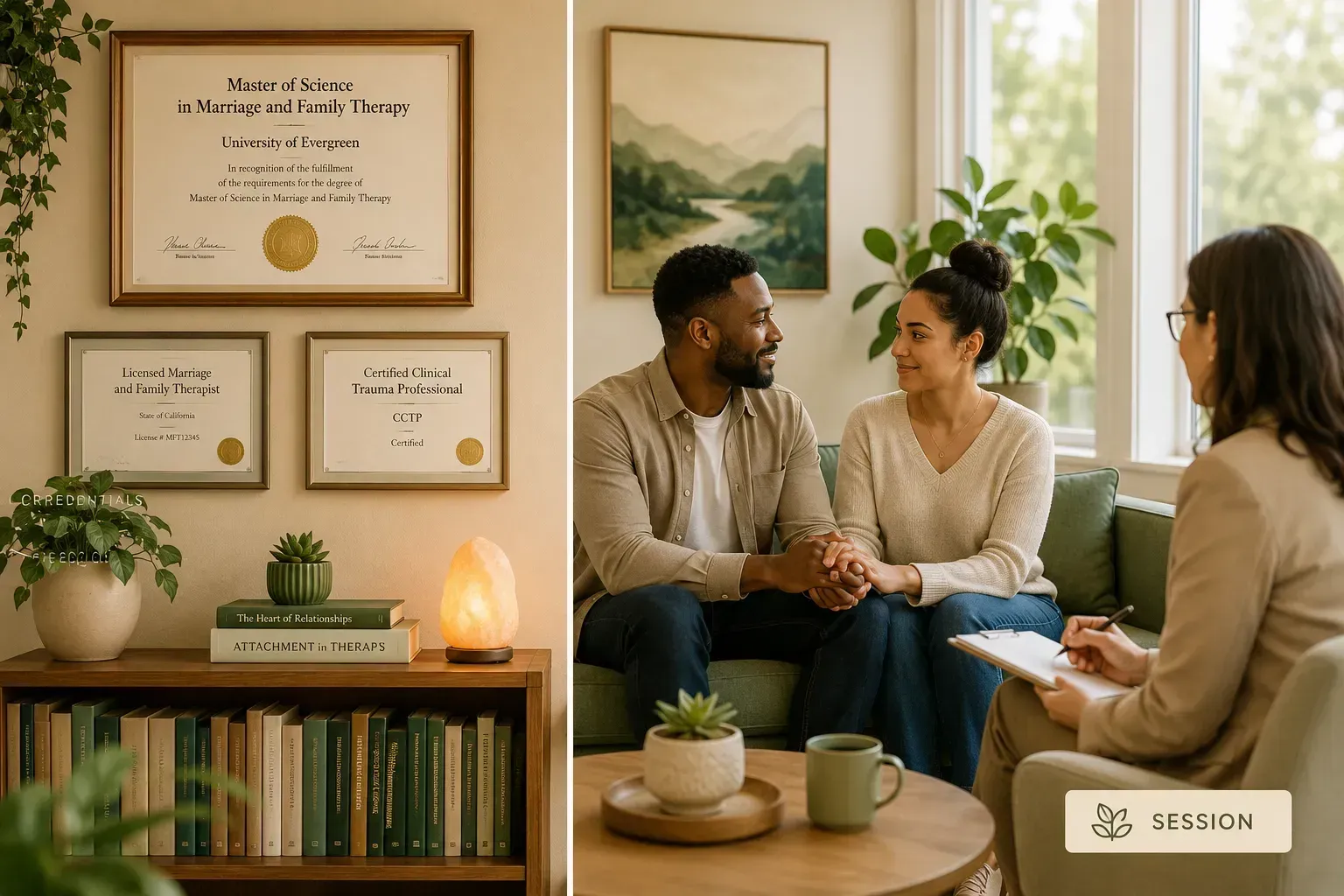
A couples therapist should hold a valid state license in mental health and have specific training in relationship or couples therapy beyond their general degree. General talk therapy training alone does not prepare a clinician for the unique dynamics of working with two people at once.
Look for these credentials:
- LMFT (Licensed Marriage and Family Therapist): Specifically trained in relational and family systems work.
- LCSW (Licensed Clinical Social Worker): Broad clinical training; many specialize in couples work.
- LPC or LCPC (Licensed Professional Counselor): Valid for couples therapy when the clinician has relationship-focused training.
- PhD or PsyD in Psychology: Doctoral-level training; look for a specialization in couples or relational therapy.
Beyond the license, ask whether the therapist has completed specialized training in a couples-specific model, such as Gottman Level 1-3, Emotionally Focused Therapy (EFT), or Integrative Behavioral Couples Therapy. These certifications signal that the clinician has invested in learning the evidence-based tools that actually help couples.
At Serenity Psychotherapy Group, our licensed clinicians bring specialized expertise in couples counseling and are committed to delivering compassionate care grounded in proven methods.
What Is the Difference Between a Marriage Counselor and a Couples Therapist?
The terms are often used interchangeably, but there are practical differences worth knowing. A "marriage counselor" may or may not hold a clinical license, while a "couples therapist" typically refers to a licensed clinician trained in psychotherapy who works with romantic partnerships.
Marriage counseling often focuses on communication and conflict resolution skills. Couples therapy, by contrast, can address deeper issues such as attachment wounds, trauma, mental health conditions affecting the relationship, and long-standing behavioral patterns. For most couples dealing with more than surface-level conflict, working with a licensed couples therapist offers broader and deeper support.
How Do I Know If Couples Therapy Is Right for Us?
Couples therapy is worth considering any time both partners feel stuck, disconnected, or unable to resolve the same conflicts on their own. You do not need to be in crisis to benefit from seeing a couples therapist.
Signs that couples therapy could help:
- You have the same argument repeatedly without resolution.
- One or both partners feel emotionally distant or unheard.
- Trust has been broken, whether through infidelity, dishonesty, or broken promises.
- A major life transition (new baby, job loss, relocation) is straining the relationship.
- Intimacy, physical or emotional, has significantly decreased.
- You are considering separation and want to explore all options first.
For deeper reading on how counseling addresses recurring conflict, see how couples counseling can help you stop negative patterns and grow together.
What Therapy Approaches Work Best for Couples?
The most effective couples therapists use evidence-based methods that have been studied and validated in research. No single approach works for every couple, which is why personalized care matters.
The most widely used evidence-based approaches:
- Gottman Method: Focuses on building friendship, managing conflict, and creating shared meaning. Based on decades of research on what makes relationships succeed or fail.
- Emotionally Focused Therapy (EFT): Helps partners identify and shift negative emotional cycles. Particularly effective for couples dealing with attachment insecurity.
- Cognitive Behavioral Couples Therapy (CBCT): Targets thought patterns and behaviors that fuel conflict.
- Integrative Behavioral Couples Therapy (IBCT): Combines acceptance strategies with behavior change techniques.
A skilled couples therapist will assess your specific situation and draw from the approach that fits your needs. To learn more about the range of therapy methods available, explore different types of psychotherapy and finding the right fit.
What Are Red Flags When Choosing a Couples Therapist?
A few warning signs can tell you quickly that a therapist is not the right fit. Catching these early saves time, money, and emotional energy.
Red flags to watch for:
- Taking sides: A good couples therapist maintains neutrality. If you feel the clinician consistently favors one partner, that is a serious problem.
- No intake assessment: A competent therapist will gather background on both partners before diving into sessions.
- Lack of specific training: General therapy credentials are not enough. Ask directly about their couples-specific training.
- Pushing a particular outcome: Whether to stay together or separate is your decision, not the therapist's.
- Poor boundaries: A couples therapist should not see one partner individually for ongoing individual therapy while also seeing you as a couple, as this creates a conflict of interest.
- Dismissing cultural or identity concerns: Your background, values, and identity matter. A culturally sensitive therapist honors those differences rather than ignoring them.
How Much Does Couples Therapy Cost?
Couples therapy sessions in the DC, Maryland, Virginia, and Delaware area typically range from $100 to $250 per session, depending on the clinician's credentials, location, and whether sessions are in-person or online. Some practices offer sliding scale fees based on income.
Ways to reduce out-of-pocket costs:
- Check whether your health insurance covers outpatient mental health services; some plans cover couples therapy when one partner has a diagnosed condition being treated.
- Ask about sliding scale or reduced-fee options.
- Consider telehealth sessions, which are often priced more accessibly.
- Look for group practices, which tend to offer more affordable rates than solo private practitioners.
Affordable clinical therapy does not mean lower quality care. At Serenity Psychotherapy Group, the belief is that accessible pricing and excellent clinical standards go hand in hand. For more on insurance and billing options, visit the insurance and billing page.
How Long Does Couples Therapy Usually Take to Work?
Most couples begin to notice meaningful shifts within 8 to 20 sessions, though the timeline depends on how long the issues have been present and how consistently both partners engage with the process. There is no fixed endpoint.
A reasonable general framework:
- Short-term (8-12 sessions): Useful for couples navigating a specific stressor or communication breakdown.
- Medium-term (3-6 months): More appropriate for rebuilding trust or addressing deeper emotional patterns.
- Longer-term (6+ months): Sometimes needed when trauma, mental health conditions, or longstanding relational wounds are involved.
Progress is not always linear. Some sessions feel harder than others, and that is normal. The goal is sustainable change, not a quick fix.
Can Couples Therapy Save a Failing Relationship?
Couples therapy can significantly improve a relationship, but it is not a guarantee of staying together. What it does offer is a structured, compassionate space to understand what is happening, communicate more clearly, and make informed decisions about the future.
Research on EFT, for example, shows that roughly 70-75% of couples move from distress to recovery with this approach (Johnson et al., 2013). Even when a relationship ends, therapy can help both partners separate with greater understanding and less harm, especially when children are involved.
The key variable is engagement. A couples therapist can provide the tools, but both partners need to be willing to use them. For a broader look at what the process involves, read the ultimate guide to couples counseling.
What Should I Expect in My First Couples Therapy Session?
The first session is primarily an assessment. A skilled couples therapist will want to understand each partner's perspective on the relationship, the history of the issues, and what both of you are hoping to achieve.
Typical first-session elements:
- Introductions and explanation of confidentiality and how it applies in couples work.
- Each partner shares their view of the relationship and the main concerns.
- The therapist gathers background on the relationship history.
- Discussion of goals and what success would look like for both partners.
- An overview of how the therapist works and what the process will involve.
Come prepared to be honest, even if it feels uncomfortable. The first session is also your chance to assess whether the therapist feels like a safe space for both of you.
What If My Partner Doesn't Want to Go to Therapy?
One willing partner can still benefit from working with a couples therapist, even if the other is not ready. Individual therapy focused on relationship dynamics can shift your own patterns, which often influences the relationship as a whole.
If your partner is hesitant, try these approaches:
- Frame it as a shared investment rather than a sign something is wrong.
- Suggest a single consultation session with no commitment to continue.
- Acknowledge their concerns directly rather than dismissing them.
- Share that many people feel nervous before their first session and that a good therapist creates a judgment-free environment.
If your partner remains unwilling, individual therapy is still a meaningful and productive step in your journey. You can also explore ways to improve communication in relationships as a starting point.
Can We Do Couples Therapy Online, or Does It Have to Be In Person?
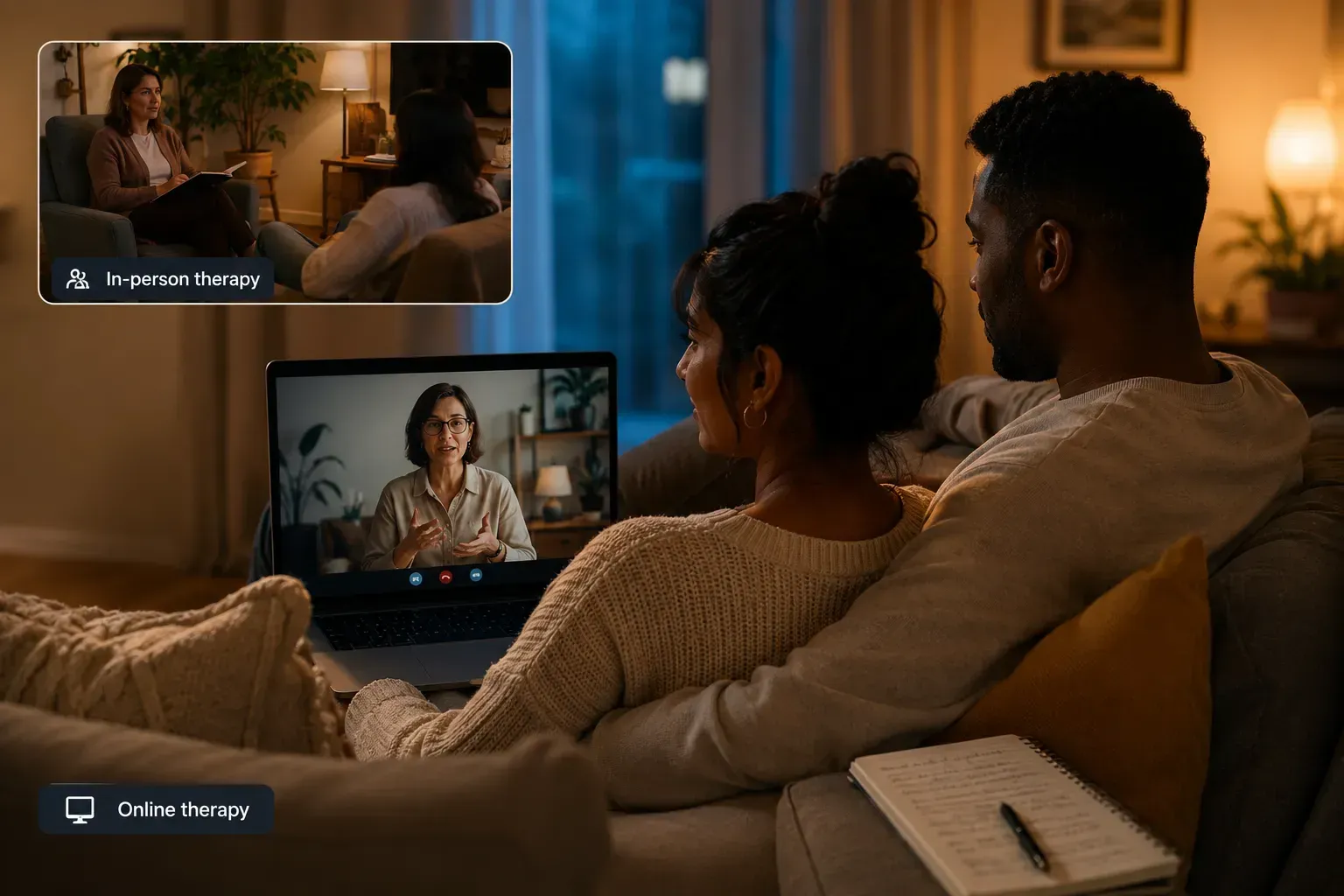
Online couples therapy is effective, widely available, and often more convenient for busy couples. Research consistently shows that telehealth therapy produces outcomes comparable to in-person sessions for most relationship concerns.
Online therapy is a strong option when:
- Both partners have demanding schedules or live far from providers.
- One or both partners have mobility limitations or health concerns.
- You prefer the comfort and privacy of your own home.
- You are located in a state where in-person options are limited.
In-person therapy may be preferable when the issues are severe, when one partner has significant trauma, or when the couple simply connects better face to face. Many practices, including Serenity Psychotherapy Group, offer both formats to support your journey in whatever way works best. Learn more about
telehealth options in the DMV area.
What Is the Difference Between Individual Therapy and Couples Therapy?
Individual therapy focuses on one person's internal experience, thoughts, emotions, and personal history. Couples therapy treats the relationship itself as the client, meaning the focus is on the dynamic between two people rather than either person alone.
In couples therapy, both partners are present (in most sessions), and the therapist works with the interaction patterns, communication styles, and emotional cycles that play out between them. Individual therapy is not a substitute for couples work, and vice versa. Many people benefit from both simultaneously, though it is generally recommended to have separate therapists for each format to avoid conflicts of interest.
How Do I Find a Couples Therapist Near Me?
Finding a qualified couples therapist in the DC, Maryland, Virginia, or Delaware area is more straightforward than many people expect. Here is a practical checklist:
- Search credible directories: Psychology Today, Therapy Den, and the AAMFT therapist locator allow you to filter by location, specialty, and insurance.
- Check state licensing boards: Verify that any therapist you consider holds a current, active license in your state.
- Ask for a consultation: Most reputable practices offer a brief phone or video consultation before committing to sessions.
- Consider cultural fit: If language or cultural background matters to you, look for a therapist who shares or deeply understands your community. Serenity Psychotherapy Group, for example, offers services in both English and Farsi. Read more about finding a therapist who truly understands you.
- Review their website and specialties: A couples therapist who lists relationship work as a primary specialty is a better fit than one for whom it is a secondary service.
- Trust your gut after the first session: The therapeutic relationship matters enormously. If something feels off after a fair try, it is okay to look for a different clinician.
Is Couples Therapy Worth the Money?
For most couples, yes. The cost of therapy is modest compared to the long-term costs of unresolved conflict, legal fees from separation, or the emotional toll on children and extended family. More importantly, the skills learned in couples therapy, including how to communicate, repair after conflict, and understand each other's needs, carry forward for years.
Consider what you are investing in: a trained, licensed clinician offering personalized care in a safe space, with evidence-based tools tailored to your relationship. That is a meaningful return on investment, both financially and emotionally.
To understand the full range of benefits, see building stronger bonds: a guide to the benefits of couples therapy.
FAQ
How do I know if a couples therapist is actually licensed?
You can verify any therapist's license through your state's licensing board website. Search by name or license number. Always confirm before your first paid session.
Can a couples therapist also see one of us individually?
Most ethical guidelines recommend against it, as it creates a dual relationship that can compromise neutrality. Your couples therapist should refer each partner to a separate individual therapist if individual work is needed.
How often should we attend couples therapy sessions?
Most couples start with weekly sessions, then move to biweekly as progress is made. Consistency matters more than frequency, especially in the early stages.
Is couples therapy confidential?
Yes, with standard exceptions (such as risk of harm). However, confidentiality in couples therapy is more nuanced than in individual therapy. Ask your therapist at the start how they handle information shared by one partner outside of joint sessions.
What if we have very different cultural or religious backgrounds?
A culturally sensitive couples therapist will honor both partners' backgrounds and work within a framework that respects your values. Ask potential therapists directly about their experience with intercultural or interfaith couples.
Can LGBTQ+ couples benefit from couples therapy?
Absolutely. A qualified, affirming couples therapist provides an inclusive and judgment-free environment for all relationship structures and identities. At Serenity Psychotherapy Group, LGBTQ+ individuals, couples, and families are warmly welcomed.
What if we are not married? Can we still see a couples therapist?
Yes. Couples therapy is for any two people in a committed romantic relationship, regardless of marital status, gender, or relationship structure.
How do we prepare for the first session?
Think about what each of you hopes to get from therapy. Be ready to share your perspective honestly, and come with an open mind. You do not need to have all the answers before you start.
What if therapy brings up painful topics?
It likely will, and that is part of the process. A skilled couples therapist will guide you through difficult conversations in a way that feels manageable, not overwhelming. Discomfort in sessions often signals that real work is happening.
Can couples therapy help after infidelity?
Yes. Many couples work through infidelity with the support of a couples therapist. It requires commitment from both partners and often takes longer than other presenting concerns, but recovery is possible.
Conclusion
Choosing the right couples therapist is one of the most important decisions you can make for your relationship. Start by verifying credentials, asking about their specific training in couples work, and paying attention to how both of you feel after the first session. Look for a licensed clinician who uses evidence-based methods, maintains neutrality, and creates a genuinely safe space for both partners.
Your journey does not need to wait until things feel desperate. Many couples find that starting therapy earlier, before patterns become deeply entrenched, leads to faster and more lasting progress.
If you are in Maryland, Virginia, Washington DC, or Delaware and are ready to take the next step, Serenity Psychotherapy Group offers affordable clinical therapy with licensed clinicians who provide compassionate, personalized care for individuals, couples, and families. Whether you prefer in-person sessions at the Rockville office or the convenience of telehealth, support is available in a format that works for you.
Schedule a consultation today and take the first step toward a stronger, healthier relationship.
References
- Johnson, S. M., Hunsley, J., Greenberg, L., & Schindler, D. (2013). Emotionally focused couples therapy: Status and challenges. Clinical Psychology: Science and Practice, 6(1), 67-79. https://doi.org/10.1093/clipsy.6.1.67
- Gottman, J. M., & Silver, N. (1999). The Seven Principles for Making Marriage Work. Crown Publishers.
- American Association for Marriage and Family Therapy. (2015). About marriage and family therapists. https://www.aamft.org
- Christensen, A., Atkins, D. C., Baucom, B., & Yi, J. (2010). Marital status and satisfaction five years following a randomized clinical trial comparing traditional versus integrative behavioral couple therapy. Journal of Consulting and Clinical Psychology, 78(2), 225-235.
- Lebow, J. L., Chambers, A. L., Christensen, A., & Johnson, S. M. (2012). Research on the treatment of couple distress. Journal of Marital and Family Therapy, 38(1), 145-168.