
Quick Answer: Your first couples counseling session is primarily an intake meeting. The therapist will ask about your relationship history, what brought you in, and what you both hope to gain. Nothing gets "solved" in session one, but you will leave with a clearer sense of direction and a safe space to begin your journey together.
Key Takeaways
- The first couples counseling session focuses on gathering background information, not solving problems immediately.
- Most sessions run 50 to 60 minutes, though some practices offer 90-minute extended intakes.
- You do not need to prepare a perfect story. Honesty, even if messy, is more useful than a polished account.
- Couples counseling and marriage counseling are largely the same thing under different names.
- A licensed clinician will not take sides or assign blame during your session.
- Communication problems are one of the most common reasons couples seek therapy, and evidence-based approaches address them directly.
- Cost varies, but affordable clinical therapy options exist, including sliding-scale fees and insurance coverage.
- If things feel harder after a few sessions, that is often a normal part of the process, not a sign that therapy is failing.
- Both partners attending together is ideal, but a therapist can still help even if one partner is reluctant.
- Serenity Psychotherapy Group serves individuals, couples, and families across DC, Maryland, Virginia, and Delaware.
What Happens in a First Couples Counseling Session
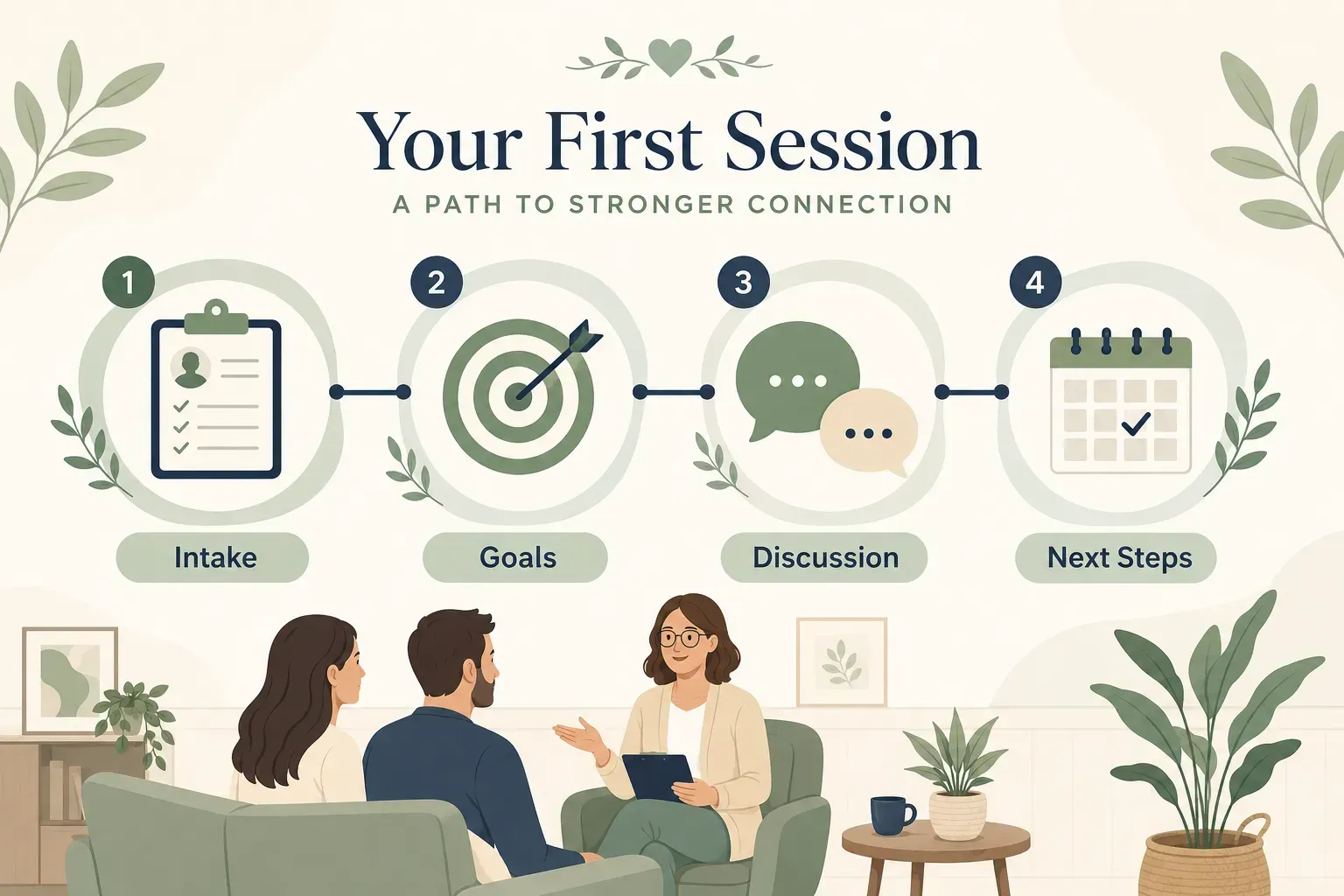
The first couples counseling session is an intake appointment, not a conflict resolution meeting. Your therapist will spend most of the time getting to know both of you, understanding the relationship's history, and identifying what each partner hopes to work on.
Here is a general outline of what to expect:
- Welcome and paperwork: You will review consent forms, confidentiality policies, and practice policies before or at the start of the session.
- Background gathering: The therapist will ask how you met, how long you have been together, and what significant events have shaped your relationship.
- Presenting concerns: Both partners will have a chance to share what brought them in. The therapist listens without judgment.
- Goal setting: The clinician will begin to identify shared goals and areas where each partner's needs may differ.
- Next steps: The session typically ends with a brief plan for future appointments and any initial observations the therapist is willing to share.
For a broader overview of the process, see the ultimate guide to couples counseling from Serenity Psychotherapy Group.
"Therapy helped us work through our challenges and improve our communication, and we're in a much better place now." - Yashar Z., Serenity Psychotherapy Group client
How Long Does a Couples Therapy Session Usually Take
Most couples counseling sessions run 50 to 60 minutes. Some practices offer 90-minute extended sessions for the initial intake, which allows more time for background history without feeling rushed.
After the first session, most couples meet weekly or biweekly for standard 50-minute appointments. Your therapist will discuss a recommended schedule based on your specific goals and availability.
How to Prepare for Your First Couples Counseling Session
You do not need to arrive with a rehearsed speech. The most useful preparation is honest reflection, not performance.
Before your first session, consider:
- Writing down two or three specific concerns you want the therapist to understand.
- Thinking about what a successful outcome would look like for you personally.
- Agreeing with your partner to listen without interrupting during the session.
- Completing any intake forms the practice sends in advance (this saves valuable session time).
- Arriving with an open mind, even if you feel skeptical or anxious.
What to bring:
- Insurance card or payment information
- Any completed intake paperwork
- A list of current medications if the practice also offers psychiatric services
- Willingness to be honest, even when it feels uncomfortable
What Questions Will the Therapist Ask in Your Couples Counseling Session
Therapists typically open with broad, open-ended questions and then get more specific as the session progresses. You will not be put on the spot with rapid-fire questions.
Common questions include:
- How did you two meet, and what drew you together?
- What has been the biggest source of tension recently?
- Have you tried counseling before, individually or as a couple?
- What does each of you hope to get from therapy?
- Are there any topics that feel especially sensitive or off-limits right now?
The therapist is not looking for a "right" answer. They are building a picture of your relationship so they can offer personalized care that fits your situation.
Should You Tell the Therapist Everything or Hold Back
You should be as honest as you are comfortable being. A licensed clinician is trained to handle difficult disclosures without judgment, and the more accurate the picture they have, the more effective the support they can offer.
That said, you are not required to share everything in session one. Trust builds over time. If there is something you are not ready to discuss with your partner present, many therapists offer brief individual check-ins as part of the couples process.
One important note: most therapists maintain confidentiality within the couple. Ask your clinician at the start how they handle information shared individually, so there are no surprises later.
What Is the Difference Between Couples Counseling and Marriage Counseling
The terms are used interchangeably. Couples counseling and marriage counseling refer to the same type of therapy. The word "marriage" was historically more common, but "couples counseling" is now the preferred term because it is more inclusive of all relationship types, including unmarried partners, same-sex couples, and non-traditional partnerships.
At Serenity Psychotherapy Group, the couples counseling services are designed to be culturally sensitive and welcoming to all relationship structures, including LGBTQ+ couples and couples from diverse cultural backgrounds.
Can Couples Counseling Help with Communication Problems
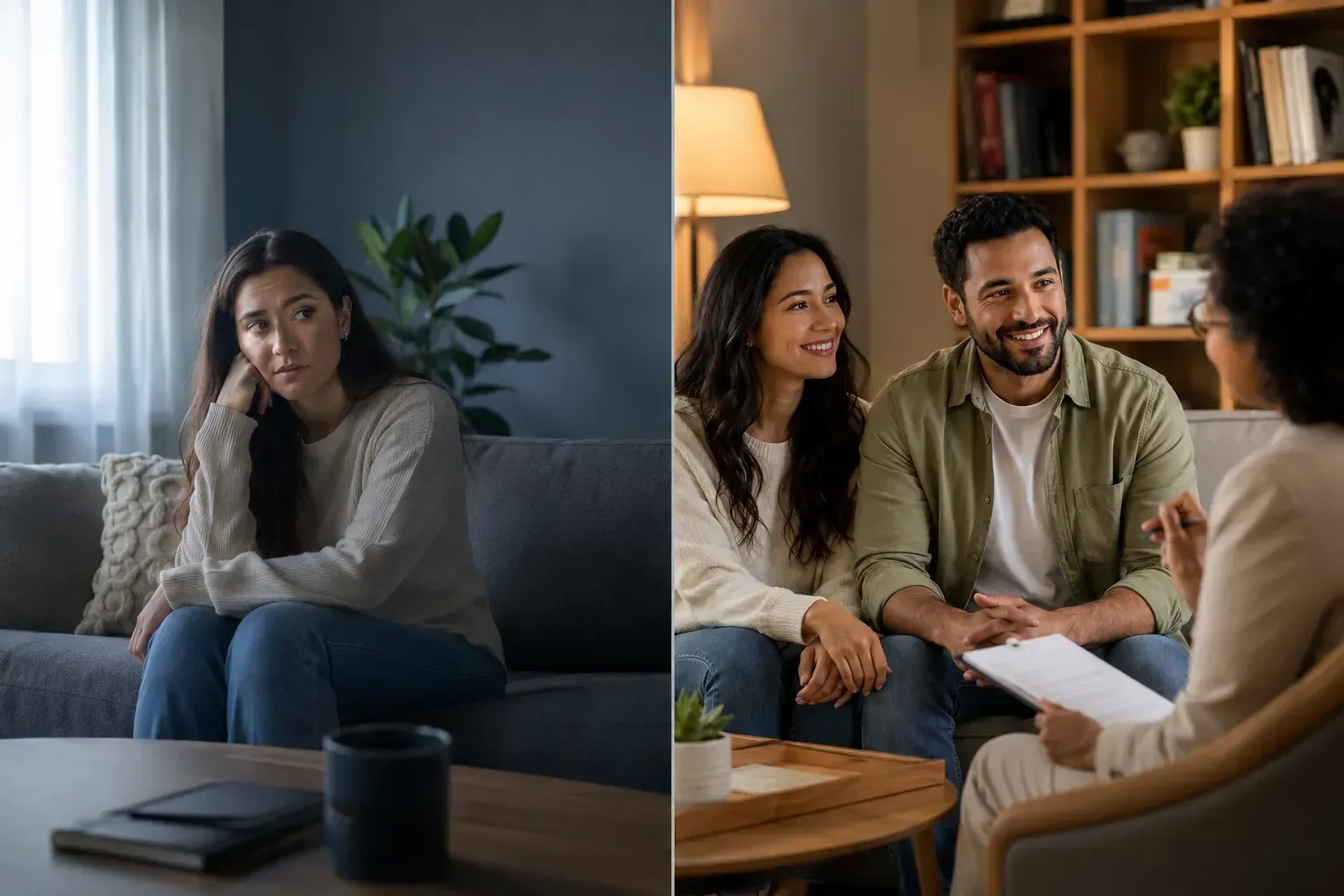
Yes. Communication difficulties are among the most common reasons couples seek therapy, and they are also one of the areas where evidence-based approaches show the strongest results.
A licensed clinician can help you and your partner:
- Identify patterns that shut down productive conversation (criticism, defensiveness, stonewalling)
- Practice active listening skills within a safe, structured environment
- Develop tools to express needs clearly without escalating conflict
- Recognize when a conversation is heading in a harmful direction and how to pause it constructively
For practical strategies you can start using now, see this guide on ways to improve communication in relationships.
How Much Does Couples Counseling Cost Per Session
Session costs vary depending on location, the clinician's credentials, and whether you use insurance. In the DC, Maryland, Virginia, and Delaware area, rates typically range from $100 to $250 per session for private pay. Many practices, including Serenity Psychotherapy Group, offer affordable clinical therapy through insurance partnerships and sliding-scale options.
To reduce out-of-pocket costs:
- Check whether your health insurance covers outpatient mental health services.
- Ask the practice about sliding-scale fees based on income.
- Consider telehealth sessions, which are often priced lower than in-office visits.
Affordable clinical therapy should never mean sacrificing quality. Serenity Psychotherapy Group's licensed clinicians provide compassionate care at fair rates for individuals, couples, and families across the DMV region.
Is Couples Counseling Worth It and Does It Actually Work
Research consistently supports the effectiveness of couples therapy. According to the American Psychological Association, approximately 75% of couples who engage in evidence-based couples therapy show meaningful improvement (APA, 2012). The outcomes are strongest when both partners are willing to engage and when therapy begins before patterns become deeply entrenched.
Couples counseling works best when:
- Both partners attend willingly, even if one is more hesitant than the other.
- Sessions happen consistently, at least once per week early on.
- Both partners are willing to practice new skills between sessions.
For more on the documented benefits, read building stronger bonds: a guide to the benefits of couples therapy.
What If My Partner Does Not Want to Go to Couples Counseling
This is more common than you might think. One partner often initiates the idea while the other feels reluctant, defensive, or skeptical.
Practical options if your partner is hesitant:
- Frame it as a shared investment, not a sign that the relationship is failing.
- Suggest a single "trial" session with no commitment to continue.
- Offer to let them choose the therapist.
- Start with individual therapy yourself. Sometimes seeing a partner benefit personally makes the other more open to joining.
If your partner remains unwilling, individual therapy can still help you build coping skills, clarify your own needs, and decide how you want to move forward. Serenity Psychotherapy Group offers individual adult therapy for exactly these situations.
What If Things Get Worse After Starting Couples Therapy
It is not unusual to feel more tension in the first few weeks of a couples counseling session. Therapy surfaces issues that may have been avoided for a long time, and that process can feel uncomfortable before it feels better.
This is sometimes called the "excavation phase." A skilled therapist will acknowledge this with you and help you manage it.
Signs that temporary discomfort is normal:
- You are talking about things you have never discussed openly before.
- Old resentments are coming up for the first time.
- You feel emotionally tired after sessions.
Signs to raise with your therapist:
- One partner feels consistently blamed or attacked in session.
- There is any escalation of harmful behavior outside of sessions.
- You feel no progress after 8 to 10 sessions.
For strategies to support your mental health between appointments, see supporting mental health between therapy sessions.
How Many Couples Therapy Sessions Do You Usually Need
Most couples see meaningful progress within 12 to 20 sessions, though this varies widely. Couples dealing with a specific issue (like adjusting to a new baby or recovering from a single breach of trust) may need fewer sessions. Couples with long-standing patterns may benefit from longer-term work.
A good rule of thumb: commit to at least six sessions before evaluating whether the approach is working. Change in relationship patterns takes time.
What to Avoid Doing Before a Couples Counseling Session
A few common mistakes can make your first session harder than it needs to be.
Avoid these before your appointment:
- Having a major argument right before the session (if possible, agree to a "pre-session pause").
- Rehearsing a list of your partner's faults to present to the therapist.
- Expecting the therapist to declare a winner or assign blame.
- Drinking alcohol or using substances before the session.
- Making major relationship decisions (like announcing a separation) immediately before or after the first session without discussing it in therapy first.
Also, avoid going in with the goal of convincing the therapist that you are right. The couples counseling session is a safe space for both of you, not a courtroom.
FAQ
What should I wear to a couples counseling session?
Wear whatever makes you feel comfortable and at ease. There is no dress code. Casual, everyday clothing is completely appropriate.
Can we do couples counseling online?
Yes. Telehealth couples counseling is widely available and just as effective as in-person sessions for most couples. Serenity Psychotherapy Group offers telehealth services across DC, Maryland, Virginia, and Delaware.
Will the therapist tell us to break up or stay together?
No. A licensed clinician does not make decisions for you. Their role is to help you both communicate more clearly and understand your options, not to direct the outcome of your relationship.
Is everything we say in couples counseling confidential?
Generally yes, but with standard legal exceptions (such as disclosures of harm). Ask your therapist to explain their confidentiality policy at the start of your first session.
What if we have different cultural backgrounds or speak different languages?
A culturally sensitive therapist will honor both partners' backgrounds. Serenity Psychotherapy Group offers care in both English and Farsi and is experienced working with diverse communities.
Do both partners have to attend every session?
Most couples therapy models require both partners to attend together. However, some therapists may occasionally meet with each partner individually as part of the process. Ask your clinician how they structure this.
How soon will we see results from couples counseling?
Many couples notice small shifts in how they communicate within the first three to five sessions. Deeper changes in relationship patterns typically take longer.
What if one of us has individual mental health concerns?
Individual concerns like anxiety or depression can affect a relationship. Your therapist may recommend concurrent individual therapy alongside the couples counseling session. Serenity Psychotherapy Group provides both services.
Is couples counseling only for relationships in crisis?
Not at all. Many couples use therapy proactively, to strengthen communication, prepare for a major life transition, or simply grow closer. You do not need to be in crisis to benefit.
What is the difference between a couples counselor and a couples therapist?
The terms are often used interchangeably. In clinical settings, "therapist" usually refers to a licensed clinician (LCSW, LPC, MFT, or psychologist). Both provide evidence-based relationship support.
Conclusion
Taking the step to book your first couples counseling session is an act of care, for your relationship and for yourself. You do not need to have everything figured out before you walk in. You just need to show up honestly.
Your first session will focus on introductions, background, and goals. It will not fix everything in 60 minutes, but it will give you and your partner a foundation to build on with the guidance of a licensed clinician who is genuinely invested in your journey.
Your next steps:
- Schedule a consultation with a licensed clinician at Serenity Psychotherapy Group by visiting the appointment page or calling 202-990-2707.
- Complete your intake paperwork in advance to make the most of your first session.
- Read the ultimate guide to couples counseling to deepen your understanding before you arrive.
- Explore how to break negative patterns in your relationship with evidence-based support.
Compassionate care, affordable clinical therapy, and a safe space to grow together are all within reach. Your journey starts with one session.
References
- American Psychological Association. (2012). Couples/marital therapy. https://www.apa.org/topics/marriage-relationships/couples-therapy
- Gottman, J. M., & Silver, N. (1999). The Seven Principles for Making Marriage Work. Crown Publishers.
- Shadish, W. R., & Baldwin, S. A. (2003). Meta-analysis of MFT interventions. Journal of Marital and Family Therapy, 29(4), 547-570.